
The season starts in the transition period

With summer officially done and dusted, many cyclists are now dialing down their riding, taking less time on the bike, and looking to rebalance their bodies and time after a season filled with riding, events, and workouts (You can check out Coach Chaz’s own transition here).
While this is traditionally the route to go (no formal training, enjoying the rides, and rebalancing life), these next twelve weeks until the end of the year may actually be the most valuable to you.
If you know how to use these twelve weeks, they are the key to your following seasonS' (yes, we are talking numerous seasons!) success, fitness, and resiliency.
Let’s take a look at how.

No breaks, just building
While we are mentally and often times also physically feeling the effects of a long season of riding, there are a number of areas in the body that don’t actually respond on the same timeline.
And in fact, this is one of the reasons why towards the end of the season your joints tend to get achey.
The graphic below shows what I’m referring to.
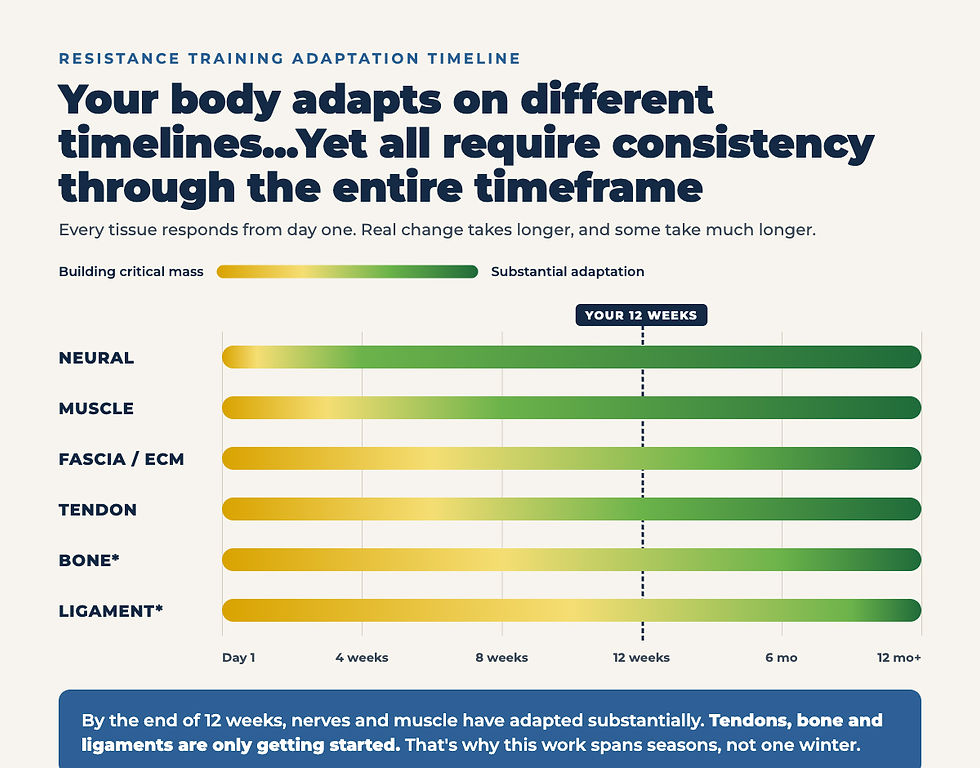
When we ride or strength train, we are creating stress on the body and the numerous tissues and systems that it is built from. Every tissue responds from day one, but on varying (and in some cases very different) timelines. Nerves and muscle adapt substantially within twelve weeks; this is one of the reasons why by week twelve of winter group coaching your cadences have improved and youre able to put out more power! Not only have you made the effort and time to learn the skill of how to create these stresses, but you've also given the tissues and systems involved the time to adapt and create substantial changes to those imposed demands. This is literally the SAID (Specific Adaptations to Imposed Demands) principle in action.
This is also why the joints tend to get achy around this point in time (the end of the season); they’ve been getting beat up and used up rather than built up over the last 20-odd-plus weeks of the riding season.
While this may sound a bit doom and gloom, there’s actually a massive bright silver lining here: If you commit to year-round strength training, it is specifically designed to aid your performance while building what Coach Tim has rightfully termed "healthspan;" you can reap some absolutely massive gains and drastically improve your next one, three, and even five years of riding and health.
This is why consistency with your strength training is so important through these next twelve weeks in particular. We're able to not only begin to give the body a dose of the anecdote it's in need of, but we're also literally changing the equation for our winter base training and future seasons.
A tale of two riders
Let me share with you a tale of two riders I have been working one-on-one with for the last two years, both in strength and cycling training. Names are changed for their privacy; we'll call her Emily and him Jake.
Emily and I have been working together for a few years now cycling and strength with some really nice results. However, she had some foot issues and was beginning to run on borrowed time towards a required foot surgery to address the issue and get her back to 100%. We carefully planned out the surgery at the very end of last season, literally two days after her A race, in order to stack the cards in her favor.
Guess what. It worked! Better than we expected.
Thanks in large part to her communication with her whole medical team, initiated and run by herself, this 60-something bada$$ wound up coming into winter group coaching with a solid energy level and trainability, while being able to keep off any weight gain, but she had worked to put on some muscle that would serve her on the bike. Through the winter her fitness and abilities kept climbing, until one day in February, she went out for a gravel ride and broke her arm. Surgery was done within the next few days, Robo-Emily was back to it just a few days after (the doc gave her very strict guidelines), and we built her up, leading her to her best year yet!
Due to our unplanned adventures in the spring, she doesn't need a down period or offseason yet, as there is a bunch in the tank. So we dropped the 1x1 strength coaching to a pre-made personalized twelve-week program to save her some dough while tripling down on the riding coaching.
Strength in this twelve-week period? Second fiddle to riding. But it is still consistent and still pushing within her abilities.
Jake, however, is at the other end. He is a 59-year-old mountain biker who just raced his first-ever world mountain bike championship and had a phenomenal season, taking the bronze medal in his age group in his country's national MTB championships.
For Jake, these next twelve weeks means lots of riding volume as we gear him up for a more demanding 2027, where he’ll be jumping tiers and needing a deeper well. We’re focusing on strength, as his sport demands require an incredibly durable body, as shown this past year when he suffered a shoulder injury in a tumble but managed to come back without missing much time and was able to push while feeling great under the guidance of a local physical therapist.
Both Jake and Emily are going to be using these next twelve weeks to build a stronger and more solid foundation for 2027, but each with a very different focus: riding for Emily and strength for Jake.

What drives the decision of what to do these next 12 weeks?
It’s not the calendar or what your riding buddies are doing, nor "what most riders do."
The decision of how to use these next twelve weeks to douse your training conditions with Miracle-Gro is what your body needs to drive the tissue adaptations your next seasons will demand.
If you’re worried about bone density or durability, these next twelve weeks are absolutely, positively, 100% instruments, as those tissues take at least three months to begin to have some kind of substantial adaptations.
If you’re like Jake and need more durability for your sport, your tendons and ligaments also need to have that consistent dosing over these next three to six months.
But if you’re like Emily, these next twelve weeks can be the thing that truly pushes your riding to new levels leading into the winter base, allowing you to actually build more fitness, and even avoiding burnout.
But you need to be able to ask and honestly answer four questions to guide that decision process:
What did this season take out of you?
What did it give you?
What will your next seasons demand?
What does your body need to adapt to meet the demands?

We must be sure to acknowledge and give mental burnout/energy its due respect. If you’re feeling burned out after the season, don’t keep on! The best thing to do in that case may be to take one or two weeks off completely from riding and do some other low-level activities like hiking and swimming, allowing your mind and body to recover from a long season and be able to use the next ten to begin to build you.
Conclusion
Understanding the timelines for different tissues in the body and what your season actually took from you and gave you, as well as looking further down the line into 2027, can help you make a more informed and better decision as to how to use these next twelve weeks to help you set yourself up for a better 2027 and beyond.
If you want to get started with a strength plan, we'd love to help; view our levels of support here.
At BaseCamp, we believe that every cyclist has the potential to achieve greatness, no matter where they start. Our mission is to create a community-driven training environment where cyclists and triathletes of all levels can train together, support each other, and grow stronger, faster, and more confident in their abilities. Our cycling training programs are expert driven and tailored to your needs. Whether you're a seasoned pro or just getting started, BaseCamp is where you belong.
Comments