
Plyometrics: What is it and why should we use it?

With an understanding of plyometrics and the science of the so-called stretch reflex movement, we can better appreciate why these movements are so valuable to endurance athletes.

Most of us have heard of plyometrics, and when it's included in a strength program, we probably have a basic understanding of what it is, but I'd like to provide a little more context. Overall, the thing to remember is that the benefit of plyometrics is developing explosive strength and reactive power. In order to get to that point, we have to build a solid foundation of strength to jump with getting injured and to benefit from explosive, reactive power moves, which is the goal of plyometrics. So if you are not already doing regular strength training, take a step back and build that foundation first before going into a plyometrics program.
A history of plyometrics
Plyometrics was first introduced in the 1960s among track and field athletes when a Purdue University track and field coach, Fred Wilt, taught these drills and exercises to link strength and speed to movement to improve explosive speed. Coaches started recognizing a widespread approval that would impact any athlete who jumped, lifted, threw, or sprinted.
Soon after Wilt brought plyometrics to athletes, a coach and friend of Wilt's, Dr. Yuri Verhoshansky, noticed the effectiveness of using explosive drills. However, Verhoshansky wasn't fond of the name "plyometrics," because he believed it could have been confused with the term pliometrics, or yielding. Verhoshansky soon introduced the Shock Method, focusing on developing explosive strength and reactive agility. The term plyometrics is still used widely throughout the western states.
Plyometrics is a stretch reflex movement demonstrating a muscle's rapid lengthening (eccentric or deceleration), followed by an immediate acceleration (concentric) movement. A simple visual of a plyometric exercise is squat jumps, where we eccentrically drop, bending at the hips, knees, and ankles, then rapidly push off the ground to jump vertically.
Verhoshansky pioneered exercises that exhibited development in the neuromuscular system to respond to explosive-reactive power drills. Depending on the desired skill for the sport's demand, plyometrics can improve absolute speed, acceleration, reaction skills, and landing mechanics. As stated before, introducing plyometrics to an athlete has benefits, but it should be monitored, and the demand on the nervous system should be considered. Depending on the movement, direction, initiation, and height, there could be 48-72 hours of muscle fatigue.
Plyometrics phases
One of the goals of plyometric training is to decrease the ground time; in doing so, we want to improve the amortization phase. The amortization phase is the time between the deceleration and acceleration phases (see Figure 3). It is overcoming the deceleration movement (muscle lengthening) to generate force to accelerate with muscle contraction through a fast recoil or spring-like action. The smaller the amortization phase, the more effective and powerful the plyometrics movement becomes.
The second critical phase is deceleration. Deceleration is frequently referred to as the braking movement, eccentric phase, muscle lengthening, and landing position. Deceleration is often the first step to a plyometrics movement, as landing correctly can help distribute the weight through the rest of the body. The development of the deceleration phase is known to generate higher gains in strength and power than the development of the shortening phase. Incorporating strength training movements with an eccentric emphasis could help with that strength-speed development.
The third phase of the plyometric move is acceleration. Acceleration is also known as the concentric action, the shortening of the muscle that rapidly occurs after the lengthening phase. This will appear on the down stroke of a cyclist.
All three phases can improve an athlete's strength and power performance. Quality over quantity is the most crucial factor when performing the plyometric activity. Form is the determining factor when improving strength, power, and speed, no matter the exercise, which is essential when performing an exercise with high-intensity efforts of 80-100%.
The three main components of a plyometric exercise are movement, direction, and initiation. These are to be used when looking at the lower body for plyometric program design.
Movement
Movement is based on the dominant movement pattern taught for a particular activity or session What motor pattern does that athlete need to learn? The three movement patterns are:
Jumping: plyometric movement with both legs
Bounding: a plyometric exercise designed for single-leg movement, alternating legs
Hopping: notably designed for single-leg movement
Direction
Direction is based on the dominant force during that activity. The three directions are similar to the planes of motion:
Linear movements are completed in the sagittal plane and go through horizontal and vertical placements
Lateral movements are completed in the lateral-horizontal and lateral-vertical direction
Rotational movements are completed in the transverse plane movement horizontally and vertically
Initiation
Initiation is the dominant muscle contraction for that particular activity or session. The three initiations are:
Non-counter movement: going through only an eccentric phase or only a concentric phase. An example of this is starting at the bottom of a squat jump with a minimal static hold, then jumping up (concentric movement).
Counter movement is an initial lengthening (eccentric) followed by a rapid shortening (concentric) movement. A squat jump is a good example of this.
Continuous movement is a movement that repeats itself more than one repetition, such as continuous box jumps.

There are various tools in the market that allow different forms of plyometric training, such as hurdles, boxes, ladders, tape, etc. No one set tool is needed to incorporate plyometrics into a program; the idea is always to consider what the athlete needs for their training.
Injury prevention
Plyometrics is underutilized for sports and injury prevention. The goal is to decrease the risk of injuries by building a tolerance to stretch-shortening activity through different training loads. The muscle spindle receptors in the muscle are sensitive to the amount of muscle stretch and the stretch rate. The stretch reflex resembles a knee-jerk response test (the one our doctors do at our annual exams). The ability to respond rapidly starts with improving the muscle lengthening to create a fast-twitch reaction; this will improve fast-twitch muscles and will enhance limiting fatigue as an endurance athlete.
Before introducing plyometric exercises into a program, a movement screening should be done to determine whether an athlete can participate in lower-leg plyometric training. In this screening, we look for a base level of strength and neuromuscular control, as well as an adequate range of motion (ROM) through the hips, knees, and ankles, with no current injuries. Once the athlete has demonstrated the baseline variables, they are ready to move to a plyometric program.
With the repetitive nature of pedaling, it is not uncommon for cyclists to experience overuse injuries. Safety is the most crucial factor to remember with athletes.
Determining workout structure
The plyometrics continuum
Power can be defined as force multiplied by distance. Two critical properties make up power: the ability to develop force during a short period (see Figure 3 below) and the ability of the muscle to continue to repeat the same force over a given amount of time.
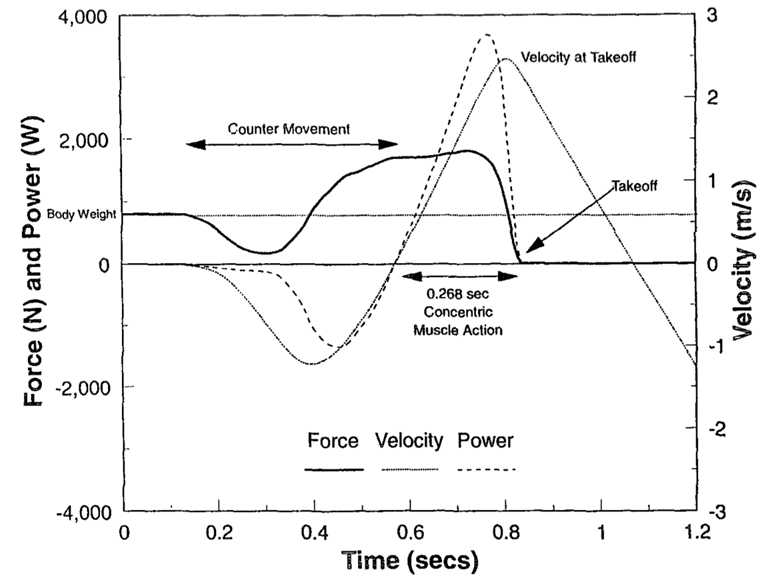
Keep in mind the two critical properties of power when designing a plyometric program that an athlete must eventually work up to a given force for a given time. These variables will help work up to those power outputs for plyometric training.
Volume: amount of accumulation
Reps: the number of times a movement is completed
Movement: jumping, bounding, or hopping
Velocity or intensity (%)
Rest between reps: determined through the work-rest ratio (high-intensity 1:5-1:10 rest, low-intensity 1:1-1:2 rest)
Recovery between sessions: the suggested recovery time between sessions is 48-72 hours (recovery is also based on how much fatigue the athlete has accumulated after the session, also known as delayed onset muscle soreness DOMS)
According to Chmielewski, et al, the volume of training (foot contacts) based on experience level is as follows:
Beginner: 80-100 contacts per session
Intermediate: 100-120 contacts per session
Advanced: 120-140 contacts per session
The volume of training (foot contacts) based on intensity level is as follows:
Low intensity: 400 contacts per session
Moderate intensity: 350 contacts per session
High intensity: 300 contacts per session
Very high intensity: 200 contacts per session
Below is an example of plyometrics programming with variables included.
Weekly Session | Sets per Session | Reps per Session | Intensity (overall % per session) | Rest per Set | Movement Direction Initiation |
Example Goal 1: Acceleration Speed, 2 times per week | 5-6 | 30-40 | 80% | 2-3 minutes | Jumping lateral-horizontal continuous |
Example Goal 2: Activation, 3-4 times per week | 2-3 | 20-30 | 70% | 1-2 minutes | Jumping linear-vertical non-counter |
References
Baldon Rde M, Moreira Lobato DF, Yoshimatsu AP, dos Santos AF, Francisco AL, Pereira Santiago PR, Serrão FV. Effect of plyometric training on lower limb biomechanics in females. Clin J Sport Med. 2014 Jan;24(1):44-50. doi: 10.1097/01.jsm.0000432852.00391.de. PMID: 24100464.
Carlock, JM. Smith, Sarah SL. Hartman, MJ. Morris, RT. Ciroslan, DA. Pierce, KC. Newton, RU. Harman, EA. Sands, WA. Stone, MH. "The Relationship Between Vertical Jump Power Estimates and Weightlifting Ability: A Field-Test Approach. Journal of Strength and Conditioning Research." 18(3):p 534-539, August 2004.
Chmielewski TL, Myer GD, Kauffman D, Tillman SM. "Plyometric exercise in the rehabilitation of athletes: Physiological responses and clinical application." J Orthop Sports Phys Ther. 2006;36(5): 308-319.
Chu, DCC. "Plyometrics: The link between Strength and Speed." NSCA Journal. 1983. PP 20-21.
Davies, George & Riemann, Bryan & Manske, Robert. (2015). Current concepts of plyometric exercise. International Journal of Sports Physical Therapy. 10. 760-786.
Nicol, Caroline & Avela, Janne & Komi, Paavo. (2006). The stretch-shortening cycle: a model to study naturally occurring neuromuscular fatigue. Sports medicine (Auckland, N.Z.). 36. 977-99.
Ramirez-Campillo, Rodrigo & Andrade, David & Izquierdo, Mikel. (2012). Effects of Plyometric Training Volume and Training Surface on Explosive Strength. Journal of strength and conditioning research / National Strength & Conditioning Association. 27. 10.1519/JSC.0b013e318280c9e9.
Verkhoshansky, Y. Siff, M. "Supertraining." Sixth Edition. Verkhoshansky SSTM; (2009). ISBN: 978-88-904038: 563-578.
At BaseCamp, we believe that every cyclist has the potential to achieve greatness, no matter where they start. Our mission is to create a community-driven training environment where cyclists and triathletes of all levels can train together, support each other, and grow stronger, faster, and more confident in their abilities. Our cycling training programs are expert driven and tailored to your needs. Whether you're a seasoned pro or just getting started, BaseCamp is where you belong.
Comments